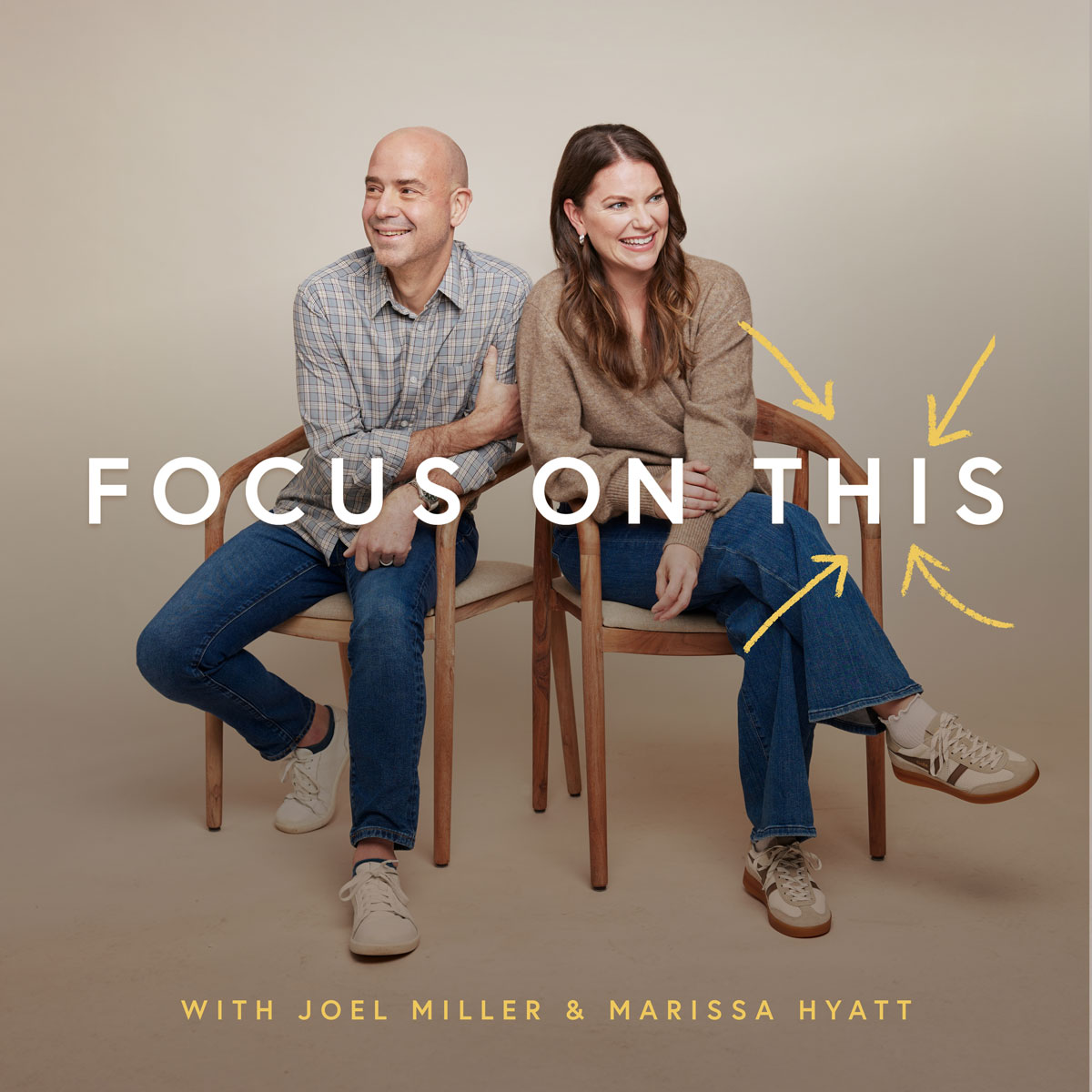
295. The Deeper Problem with Distractions
Audio
Overview
You know what distracts you. But do you know why? In this episode, Joel and Marissa dig into the real source of distraction—and it’s not your phone, your boss, or the pile of laundry calling your name. Nearly half the time, we’re interrupting ourselves. The good news: once you understand what’s driving your distraction, you can actually do something about it. Less white knuckling, more momentum.
Key Takeaways
- You Are the Biggest Distraction. Research shows we self-interrupt about 49% of the time. External interruptions get the blame, but the real culprit is usually us—reaching for something easier the moment things get hard.
- Your Brain Is Optimizing for Easy. Distraction spikes when tasks get difficult, boring, or tedious. That pull toward Instagram or your inbox isn’t laziness; it’s your brain chasing a dopamine hit over a delayed reward.
- Design Your Environment to Win. Willpower runs out, especially as the day wears on. The smarter play is to remove temptations before they become a choice: turn off the phone, close the door, change your Slack status, and tell your team in advance when you’re going dark.
- Lower the Bar to Raise Your Output. Making the hard thing more enjoyable is often more effective than trying to make yourself tougher. Temptation stacking, time-bounded work sessions, and background music might feel like cheating, but they’re actually strategic.
- Frustration Tolerance Is a Muscle. And like any muscle, you can build it. Every time you acknowledge that something is hard or boring and do it anyway, you’re making it a little easier to do the next hard thing. That’s the essence of maturity: doing something you don’t like to get a result you do like.
- A Real Break Is Productive. Distraction is sometimes your brain’s way of signaling it’s spent. A 10-minute walk, a snack, or even a bath beats scrolling social media—and you’ll come back sharper for it.
Watch on YouTube at: https://youtu.be/Ozw8NflvpRw
This episode was produced by Sarah Vorhees Wendel of VW Sound
Episode Transcript
[00:00:00] Joel: You probably know what distracts you, those specific apps, stopping work to do chores, spending too much time in your inbox, or maybe just TikTok. But do you know why you get distracted? That’s the real question. What causes you to stop focusing on what you know deserves better attention, your best attention, and more importantly?
[00:00:26] What can you do about it?
[00:00:32] Welcome to Focus on This, the most productive podcast on pretty much the entire internet. I’m Joel Miller.
[00:00:39] Marissa: And I’m Marissa Hyatt.
[00:00:41] Joel: And this is where we remind you of something you already know. It’s not about getting more things done, it’s about getting the right things done,
[00:00:49] Marissa: both at work and in life. And today we’re talking about distractions.
[00:00:55] How we can manage them more effectively.
[00:00:58] Joel: Is that possible?
[00:00:59] Marissa: Yes. Before we dive in, I want us all to imagine that we’re living on the honest planet, which may not be our favorite place to go, but we’re gonna go there. No, right off the bat today. So ask yourself this, and Joel, I want us to answer this. What are you most likely to use to distract yourself?
[00:01:18] Is it people, apps, housework, group text? What is it? Joel, what is it for you?
[00:01:25] Joel: For me, it’s social media.
[00:01:28] Marissa: Yeah.
[00:01:28] Joel: It’s X and Substack for me. Yep. The notes part of Substack.
[00:01:33] Marissa: Yeah. For me it’s Instagram. No doubt. I mean, I’ll be watching tv, an TV episode or a movie and get on, you know, Instagram, I mean, it’s like stupid.
[00:01:45] And during work, you know, it’s interesting, the house chores for a lot of us were working at home. And that is something that I, you know, I get up and I’m like, oh yeah, I need to change the laundry or lemme go do the dishes really quick. So that definitely can be a distraction, especially when I’m working at home.
[00:02:03] Joel: I saw somebody post the other day about a television show that it was, speaking of posting on X, that this show was so good. It was a laptop closed show, not a laptop open close show, you know? So
[00:02:16] Marissa: isn’t that interesting? That’s now kind of a new distinction. Wow.
[00:02:19] Joel: Right.
[00:02:20] Marissa: Okay. So next question. When do you find yourself most prone to distraction?
[00:02:27] Joel: Um, this is the easy one to answer. It’s like whenever I am in the middle of doing something hard,
[00:02:32] Marissa: yes,
[00:02:32] Joel: I am, uh, working on a report or I am writing something or whatever, and it’s like. I go take that micro cigarette break that is a check on X to see what’s going on, and I just bounce to the thing that’s easier
[00:02:49] Marissa: for me.
[00:02:50] It’s the same during the workday, but I would say in my day I’m most prone to distraction late at night.
[00:02:58] Joel: Yeah.
[00:02:59] Marissa: As the day goes on, it feels like I become more prone to distraction. I, I tend to be a little bit more focused earlier in the day, and as it goes on, that really becomes less and I become more distracted.
[00:03:11] Joel: There’s a whole realm of psychological research around that called ego depletion, and there’s some question as to how valid it is, but I think we all practically know it from experience that. When we’re tired, worn out, whatever, our ability to do the things that we want to do, plummets and our ability to justify doing something different, something less advantageous tends to go right up.
[00:03:40] Marissa: Yeah. Well, research by Gloria Mark in her book Attention Span showed that people, this is so crazy to me. People spin on average. Just 47 seconds on any one screen, 47 seconds before shifting their attention elsewhere.
[00:04:00] Joel: But at least it was as high as 2.5 minutes when her research began, like 22 years ago.
[00:04:05] So we were able to focus for a really long time back then. Two minutes. That doesn’t even seem like very much.
[00:04:12] Marissa: Don’t they say that we now have the attention of a goldfish?
[00:04:15] Joel: Something like that?
[00:04:16] Marissa: I think it’s actually supposedly like less than that now. I don’t know that that’s true. I would have,
[00:04:21] Joel: I mean, how are they polling these goldfish to find out how long their attention spans are?
[00:04:26] Marissa: Well, regardless whether we’re. Walking goldfish or not. What’s interesting about this, obviously 47 seconds is no time at all. We likely feel this, but it can actually take up to 25 minutes to return our attention to a project after interruption.
[00:04:43] Joel: Gloria, marks research on this is really valuable. I actually talk about this on our coaching calls all the time with people.
[00:04:50] When we do work, we have to assemble like this cognitive frame. We’ve talked about this on the show before. We have to assemble this cognitive frame. Of the various ideas and concepts that we’re working with in order to like productively do the thing that we’re doing. And it takes effort to do that. And it takes effort to hold onto it.
[00:05:09] And so like when you get interrupted, it’s like you get this whole other cognitive frame that bumps into it. So let’s say this never happens, but let’s say I’m working on something and you text me and. I gotta go drop the thing that I’m working on. I gotta go figure out what it is you’re actually asking me.
[00:05:26] I gotta go possibly find out data or something to answer the question, and then I come back and answer you. Now I have to go like unscramble my prior state of mind, right? Pull it all back together again and get back to work. And that can take, like she says, 25 minutes here on average. In some cases it’s longer because maybe I don’t even get back to the thing I was working on.
[00:05:49] Right?
[00:05:50] Marissa: And we all feel this. I mean, the biggest, glaring. Experience we have probably in our work lives of this, is when your boss calls,
[00:05:58] Joel: right?
[00:05:58] Marissa: And they say, Hey, or they text you and they say, Hey, can you, you know, they have a question and in your mind it’s urgent and so you need to go.
[00:06:05] Joel: Real quick question.
[00:06:06] It’s always a quick question.
[00:06:07] Marissa: It’s always a quick question and it never is a quick response, right? Right. It always takes some level of digging or whatnot for us to do. But what’s interesting about this, Joel. Is it’s actually not our bosses or our coworkers mm-hmm. Or other people that are doing this the whole time for us,
[00:06:26] Joel: your boss is not interrupting you every 47 seconds.
[00:06:29] Right.
[00:06:30] Marissa: The truth is, is that we are self interrupting 49% of the time. That’s crazy to think of.
[00:06:37] Joel: 40%
[00:06:38] Marissa: of the time we’re doing it to ourselves,
[00:06:40] Joel: right? You are the enemy half the time.
[00:06:42] Marissa: Yeah. And so just to even further prove this, people and all of you listening, you’re gonna go, oh yeah, we’re checking our email guys, this is bananas To me, on average, this is on average.
[00:06:56] 77 times a day.
[00:07:00] Joel: That means there are some zen-like users out there who are checking it twice, three times a day. And then there are some like frantic hamster users that are literally checking it 200 times a day,
[00:07:12] Marissa: which like, God bless all of you because I can’t imagine. And if it’s not email for you, it’s probably Slack or your text messages.
[00:07:20] And if you don’t believe us. Just go look at your screen time, oh, the history, your iPhone user, and look at how many times you have iPhone pickups or phone pickups. That’s the worst is it’s like that impulse to grab it and to pick it up and to look at whether it’s text or social media or email. It’s awful.
[00:07:39] Yeah. Like the story here is that we are incredibly distracted and we’re doing it mostly to ourselves.
[00:07:44] Joel: I think that’s the important thing actually to kind of drill into for just a second, because it would be easy to blame the device. It would be easy to blame the boss. It would be easy to blame the coworker, right?
[00:07:57] It would be easy to blame anything outside of ourselves, but we are literally our own worst enemy at least 50% of the time or about 50% of the time. And that means that there’s a deeper problem going on here. There’s a more insidious problem happening because, and I alluded to this in my answer on X, like what are the apps that distract me or the things that distract me?
[00:08:21] The problem is that we. Don’t have the frustration tolerance. We need to stick with the hard stuff that we’re working on. So when we are, you know, like focused on a task, as the difficulty of that task increases, so does the chance that we are going to self-sabotage and bounce out of that task to go do.
[00:08:42] You know, the micro social media cigarette break, and you do that over the course of a day and your productivity gets sunk. You know, like when you have boring or tedious tasks, when you have things that don’t create instant results. When you have stuff, you just find hard, stuff you find challenging. And
[00:08:59] Marissa: basically the majority of our work,
[00:09:01] Joel: I was gonna say, like all the meaningful stuff that we do is challenging, right?
[00:09:04] The non meaningful stuff is easy. Walking out to get the mail, pulling up Instagram or whatever, that stuff is easy. It’s the hard stuff, like the button, the chair stuff. That is the difficult stuff, and that’s where we’re most likely to self interrupt because we have low frustration tolerance.
[00:09:21] Marissa: Yeah. And we want to look for the things that are easy, that are more enjoyable, that give us that dopamine hit, right?
[00:09:30] Right. And so those distractions are literally more fun to our brain,
[00:09:35] Joel: right?
[00:09:35] Marissa: So why the heck would we sit there and deal with a boring task or a difficult task when we can open any app on our phone and get an instant hit or go read our Slack messages or our email? And feel like we’re making progress even though we’re not.
[00:09:53] We’re just distracting ourselves. But it feels like that. It feels better, it feels more instantaneous, and you’re exactly right. It’s that we have, I think, our frustration tolerance, maybe that is what we have that is similar to a goldfish.
[00:10:06] Joel: I sometimes think about, you know, those studies back in the day where they like put monkeys in a cage, chimps in a cage or whatever, and they hook ’em up with some lever where they can self administer cocaine.
[00:10:16] And they just like let ’em crank the lever as often as they want. And we’re not monkeys. We have choices that we can make. But what’s critical about that idea is the dopamine hit that that monkey is getting and the ability to just keep doing it like. My phone is like a cocaine lever sitting there in my pocket.
[00:10:37] And unless I develop, and it’s not the phone’s fault, like it’s just a thing. The fault is in me, the inability to say, I don’t want that hit right now. I need to just stay focused on this thing.
[00:10:49] Marissa: Yeah. And ultimately, we don’t wanna be the kind of person that is sitting there in a cage just hitting the lever over and over.
[00:10:56] Right, right. We wanna become the kind of people. Who can get ourselves to do stuff that we don’t wanna do because we’re really committed to the end result.
[00:11:05] Joel: Right.
[00:11:06] Marissa: Andy Andrews, who is a good friend of my dad’s, he’s talked about this, I don’t know the exact quote, you may know it, something to the effect of, you know, can you get to do something you don’t wanna do to get to a result that you want?
[00:11:18] Joel: Right. I think that’s like his definition of maturity.
[00:11:21] Marissa: Yeah.
[00:11:21] Joel: Is can you do the thing that you don’t want to do to get to a result that you do want and. Like that’s what it looks like to be a grownup, which is, I guess why everyone says adulting is hard, but the world keeps spinning and rent needs to be paid and all kinds of other things needs to happen.
[00:11:36] And that only means that we need to become a different kind of person than the kind of person we are right now.
[00:11:41] Marissa: Yeah. So like how do we actually do this? Because. It would seem that sheer willpower or discipline, for instance, isn’t gonna cut it.
[00:11:52] Joel: Yeah, I mean, it can, right? But back to that ego depletion idea again, when you’re tired or you’re worn out or whatever, and by the way, if you’re doing a difficult task, it’s gonna be weary.
[00:12:02] Like you’re gonna bounce your willpower’s automatically not gonna kick in the way you, you know, you would hope. There are a handful of things that you can do. So like first you can proactively design your environment to support the success you’re looking for. This is self-evident. It’s obvious, but it’s one of those things that we don’t.
[00:12:21] Actually probably think about enough, like there are design solutions to some of these internal problems, like external design solutions. Yeah. So you can, for instance, instead of counting on your discipline, which is not gonna come through for you, you can create environments with fewer temptations to distraction.
[00:12:40] And you know, like that’s obvious maybe, but I don’t think it’s something that we proactively do. And what we’re saying here is. Go ahead and note where you’re gonna fail, like where your frustration tolerance is gonna give in and prepare in advance environmentally for some of those things. So like for instance, if you’re tempted to like.
[00:13:01] While you’re working on a project bail and go do something else, like the laundry or something like that. Leave the house, right? Go to a coworking space, go to a coffee shop. If you’re tempted to clean around the office while you’re putting off doing that thing you need to do, like straighten it up in advance.
[00:13:20] If you’re tempted to misuse your phone like I did before this call started, I turned it off. Yes. I didn’t even, I didn’t even trust do not disturb. I just turned it off. If you’re tempted to go talk to colleagues and who wouldn’t be, colleagues are great. Go into a room by yourself and close the door. Go dark on slack.
[00:13:38] You know, like there are environmental things that we can do to like reduce the number of opportunities we have to self-sabotage.
[00:13:45] Marissa: Can I say a note about that? Because I think we hear this a lot in our coaching program that people feel like they can’t go dark.
[00:13:52] Joel: Right,
[00:13:53] Marissa: because they’re accountable to their boss.
[00:13:55] I get that objection all the time when I say, you know, they’re, they’re talking about how they can never get to deep work. They can’t get anything meaningful done because they’re, they need to be available to their boss or appear available. They don’t want to appear unresponsive or something like that.
[00:14:10] And I think it’s important to note here, first of all, we are all adults. Okay? So like. By and large, we are not people who are really irresponsible like most of us are. Have a job that we’ve been holding. We’re making a living. We have a lot of responsibility in our lives. So just the idea that you’re off like dilly dallying is typically not the first thing your boss is gonna think.
[00:14:35] Now, they may feel frustrated, not usually. Yeah, if they’re trying to get ahold of you and they can’t get ahold of you and then they’re gonna start questioning what, what are they doing? And really the simplest solution to this is tell them in advance
[00:14:48] Joel: you can do that.
[00:14:50] Marissa: This is so like basic, but I genuinely think people don’t think this is an option on the table.
[00:14:56] And my team does this all the time with me. I do this with them. I do this with my boss, Megan. Where I say, Hey, I’m gonna go dark for several hours to work on a project if you need me, I’ll be checking in at. Whatever time I’m gonna be checking in. Right. And in fact, actually Megan just did this to me before we got into this podcast recording.
[00:15:18] She and I were going back and forth on something we were trying to solve that we need to finish up by the end of today. I don’t think she knew that I was going into this. And she said, Hey, by the way, like she had given me her answer and she said, by the way, I’m going dark for the rest of the day. Right.
[00:15:32] All I need to know because then if I’m trying to get an answer from her and I can’t, and I’m frustrated, or if, if the roles were reversed and she was frustrated with me and questioning, you know, is Marissa out like at the nail salon or like, what is she doing? She would know, oh, she’s going to, to work on this project.
[00:15:49] Joel: Yeah.
[00:15:50] Marissa: So just. Note that for yourself, for your own sanity, it’s kind of like putting a do not disturb sign on your office door, which most of us, a lot of us are not working with an actual office door anymore. You can literally do this in Slack. You can change your status to deep work until 1230, so your team knows when you’re gonna come back online.
[00:16:11] You can text your boss, you can text your team and tell them you don’t have to be a slave to availability. Right. And I think a lot of us think that we’re supposed to be available 24 7. To, whether it’s our colleagues or our bosses, and that’s just not the case.
[00:16:25] Joel: When we think about designing the environment to support the success that we want to see, one of the key ingredients to remember is that you know your temptations, and if you’re the person that self sabotages, half of the time, you’re also the right person to solve it.
[00:16:41] You know? Right. Like nobody knows your problems like you know your problems. And so if we take some ownership in this and say. I know where I go astray. I’m gonna solve that in advance. You’re gonna get better results than if you just hope for a better outcome. ’cause it ain’t coming,
[00:16:57] Marissa: right? So you’re gonna have to, you know, have an honest look in the mirror and ask yourself like, where am I getting tempted to get distracted?
[00:17:04] Or to pick up my phone and look at Instagram or X or whatever it is for you. And then ask yourself, what do I need to do? Like for instance, I actually just bought a brick, which I’ve talked about several times on the show. I’ve never had one. It’s kind of embarrassing. I bought it a week ago and I haven’t even touched it.
[00:17:20] So that tells you how distracted I’ve been in the last week. But I bought this because I’ve heard such amazing things actually from our team about using it. It’s a device that will lock down certain apps on your phone. You can have different modes. You can have a work mode, you can have even a deep work mode.
[00:17:39] You can have like a quiet time or an evening ritual. You can create all these different customizations around it. And it locks down certain parts of your phone and supposedly I have yet to use it. But when you try to to open it, whatever that app may be that you have locked down at that time, it’ll say something to the effect of.
[00:17:57] Basically you’re missing out on actually living life right now.
[00:18:00] Joel: Don’t you have something better to be doing right now?
[00:18:02] Marissa: Yeah, it like, you know, gives you a little dose of shame, I think, in there, which is probably pretty effective in this case. So if you’re somebody who, you know, even turning your phone on silent, for instance, isn’t going to really do the ticket you could get.
[00:18:15] An actual device, like a brick that will help you do this. So that was my strategy. I have yet to implement it, but I’ll report back when I,
[00:18:22] Joel: but it’s a great example of designing the environment to work for you, right? Yeah. Because you’re gonna proactively set some restrictions, some boundaries. A design for how you want to, you know, be at work, at home and so on in relationship to your phone.
[00:18:36] And that’s just one thing that you can do, right? ’cause the truth is there are other things you can do. So if we’re talking about designing your environment to, uh, improve your success, a second thing you can do is to just lower resistance. You can, if this is a frustration tolerance problem, fundamentally then like where can you lower the resistance?
[00:18:54] Where can you take out the friction? Where can you pull out that frustration?
[00:18:58] Marissa: Yeah. Like how can you make the very difficult thing more enjoyable? You know, there’s something called temptation stacking.
[00:19:06] Joel: Mm-hmm.
[00:19:07] Marissa: Where you can pair an activity you enjoy with one you may feel resistant to. So. This may be, we talked about a coworking space.
[00:19:15] Maybe you have a favorite coworking space or a favorite coffee shop, and going there gives you that enjoyable fix that you need, but allows you to actually get the work done that you need.
[00:19:26] Joel: Right?
[00:19:26] Marissa: Could be something, you know, if we’re talking about something outside of work, for instance, like trying to get a workout done and you’re somebody who’s like, yeah, I just don’t wanna do it.
[00:19:35] Uh, you keep butting up against that. Maybe you need to find a different type of workout that you actually really enjoy or pair it with somebody you enjoy being with.
[00:19:44] Joel: I was just gonna say like, one of the best ways to make working out work is to do it with someone you love hanging out with.
[00:19:51] Marissa: Yeah. It really takes a lot of the friction out and sometimes we just think willpower is the only answer we have to like white knuckle this stuff.
[00:19:58] I remember I had a, a therapist one time tell me, you know, you don’t actually have to white knuckle all of this stuff. Right.
[00:20:05] Joel: Right.
[00:20:05] Marissa: Wow. And I genuinely was like, what? I thought that was the only option on the table was just to suck it up and do it anyway.
[00:20:12] Joel: Well, we kind of have this idea that like we’re a better person if we do that.
[00:20:17] You know, like rather than recognize our weaknesses and come up with solutions for the weaknesses, we’re like, no, we’re gonna become strong. Right? And we just like decide that we’re gonna basically testosterone our way through whatever the problems are that we have, instead of recognizing that maybe I could adjust the problem.
[00:20:35] Which might actually be a better solution.
[00:20:49] Marissa: I think another great way to do this is to give yourself boundaries or boundaried periods of time, right? So rather than saying, I’m gonna, you know, go work for four hours on this project, I don’t wanna work on that’s gonna be challenging or boring or tedious. Just say, what if I could only do this for 30 minutes?
[00:21:07] What if I set a timer and just get 30 minutes of the hard thing done? Going back to the workout kind of thing, rather than saying, I’m gonna go do this for a full hour. What if you just did 10 minutes?
[00:21:19] Joel: Right?
[00:21:20] Marissa: Usually the hardest part is getting started, and once we get in the rhythm of it, we can usually go longer than we think we need to.
[00:21:28] Joel: It also helps with the Gloria Mark thing we talked about earlier, this cognitive frame problem, like if you set a 30 minute window or an hour or whatever it is, you decide to work 15 or say it’s 45 minutes and you’re gonna give yourself a 15 minute break. If it’s predictable, it’s actually easier to go back and reconstruct that cognitive frame to get back into the work.
[00:21:48] Yeah. So like if you have this predetermined time, you’re gonna work and you’re just gonna hold yourself to account for a limited time. It’s not open-ended, so it’s not like gonna be automatically sort of self-defeating from the beginning. You know, I only have to do it for 45 minutes or 30 minutes, and then you have some kind of reward at the end of it.
[00:22:04] A break or whatever. It’s easier to get back in the right head space again because you’re intentional about it, and that means you haven’t let that whole mental frame go during the break. You’re holding onto enough of it that you can reconstitute it quickly and get back to work when you come back. And that’s a game changer potentially.
[00:22:23] But ultimately, here what we’re saying with this second point is that if it’s a frustration tolerance problem. Remove some of the frustration, like yeah, you have control over it, lower the bar a little bit and you’ll make more progress.
[00:22:37] Marissa: Yeah. And really think outside of the box here, like what would make it more enjoyable?
[00:22:42] And I think we forget sometimes that we can create this to look like what we want it to look like,
[00:22:48] Joel: right?
[00:22:48] Marissa: Maybe that’s putting on some music that helps us focus and helps us stay engaged in a different way that feels more enjoyable. But doesn’t distract us. Yeah. Like some kind of classical instrumental or spa type music that doesn’t have any vocals can be a really effective strategy for making it feel more enjoyable and.
[00:23:07] May give ourselves our brains, something else to kind of have going and can actually improve our focus.
[00:23:13] Joel: I listen to jazz like all day long for precisely this reason. Yeah,
[00:23:18] Marissa: and for me it’s spa music, so we’re a little bit different in that, but yeah,
[00:23:22] Joel: different strokes for different folks. But you find the thing that enables your brain to kind of do what it wants to do while you’re doing the thing that you need to do.
[00:23:29] And it’s, it is really enjoyable.
[00:23:32] Marissa: All right. Third is that we want to acknowledge the reality and also recommit. So you can say, I don’t wanna do this. You can have your fit, right? And it’s important, so I’m gonna do it anyway. Like we’re not the toddler who just gets to lay there. Wailing, kicking, screaming, saying, I don’t wanna do this.
[00:23:53] Like we all are adults. So we can acknowledge that and have that moment and also say, well, it’s also important, so I’m gonna go and do the thing anyway.
[00:24:02] Joel: It is actually liberating to be able to say, you know, this sucks and I’m still gonna take care of it.
[00:24:08] Marissa: And you know, it’s really an exercise in our own self-leadership.
[00:24:12] Joel: Yeah. So
[00:24:13] Marissa: all you have to do here is just. Notice it, acknowledge it. Validate your internal experience and say, yep, I know that this sucks, or this is gonna be boring, or This is not enjoyable for X, Y, or Z reason. Or, this is gonna be really hard and you go do it anyways. Right? And trust me, that like when you go do that thing, when you look back and you say, yeah, that sucked, and I still did it anyways, man, that feels good.
[00:24:39] Joel: Well, and you know, back to the working out analogy, this is like exercise for your frustration tolerance. So a frustration tolerance is the thing that we’re really struggling with. We get the benefit of like building that muscle. The more we actually do that. What does
[00:24:56] Marissa: enable variance? Split squats.
[00:24:58] Joel: Yeah, so exactly.
[00:24:59] Oh my gosh. They’re
[00:25:01] Marissa: the worst exercise. I’m convinced of it.
[00:25:03] Joel: Weighted Bulgarian split squats are like how? I swear in my mind I just think hundred percent Bulgarian split squats. It’s like such a pain. And yet. They get easier the more you do them and the weight goes up, the more you do them and you’re just able to tolerate more, which when we’re talking about frustration, tolerance is kind of the game to win.
[00:25:24] If we can somehow build that muscle, this issue starts to get less and less of an issue. It just becomes easier to manage. And then instead of self-sabotaging, 49% of the time we’re self-sabotaging like. 30% of the time. Right. And then maybe 20% of the time.
[00:25:39] Marissa: One practical example of this is, I don’t know, a year ago or so, we implemented a few things on our marketing team where every single morning several of us would need to be logging specific KPIs.
[00:25:52] Okay. So, um, that’s like
[00:25:54] Joel: my least favorite three initials outside of IRS is KPI.
[00:25:57] Marissa: Totally. Yes. It, especially for those of us that don’t have a long follow through, this is just like boring, laborious. Yeah. So, ugh, my eyes cross. Okay. This initially for me to do this was so frustrating, and for me to get my team to do this was so frustrating.
[00:26:16] It was annoying. I hated nagging them. Hey, you didn’t fill your sheet out today. And this was like, we were supposed to do this literally five days a week, and it sucked every single time. Well, the truth is. That. As we started to do that, we started to gain insight into whatever it was that we were reporting on.
[00:26:32] So whether that was our email performance or our ad performance or what have you, whatever the, the thing was that we were looking at. And through that we started to gain insight and that made it less frustrating. Right? Right. And then the more we did it, like we’re talking about the Bulgarian split squats, we started gaining the muscle strength.
[00:26:53] Right? And so then it just became this kind of routine thing that we did, and we no longer felt that friction or frustration every single day. It just was like what we did, it was who we were, right? It became part of our identity as a marketing team. And now a year-ish later. I don’t even think about it. I just log that stuff.
[00:27:12] No big deal. I actually look forward to it now because I know it’s gonna provide insight, right? And it’s gonna make us better, and it’s gonna open up more possibility for solutions because now we know what we’re solving for, rather than wondering what the issue is in the first place and hoping, you know, we throw a bunch of things at the wall and hope something sticks.
[00:27:31] Now it’s like, oh, that metric is off. Okay, what can we do to affect it?
[00:27:34] Joel: Totally. Alright, so we’ve talked about designing your environment to support the success that you want to experience. We’ve talked about lowering the resistance where you can, we’ve talked about acknowledging the reality and just recommitting.
[00:27:49] Finally, you can take a break every now and then. What? What is it? The expression. What if it were easy? You know, like sometimes you actually can. Just take the break that you need and if you acknowledge that on the front end and plan for it even, it’s gonna be a lot easier to do. Sometimes distraction is actually signaling to us that our cognitive resources are spent, you know, back to that ego depletion idea that like we’ve got store of energy, that we can give to something and eventually it gets exhausted.
[00:28:22] And if it is exhausted. You’re not gonna make any real progress by just back to that white knuckling idea. Just like trying to force yourself through, force it through. You’re gonna need to like take a break, like go on a walk, have a snack, talk to a friend, do something like that so that you can kind of feel some restoration and then get back to it when you’re ready.
[00:28:44] Marissa: Yeah, it’s pretty incredible design actually, that our brain signal to us like, Hey, I, I need a break.
[00:28:50] Joel: Right?
[00:28:50] Marissa: By trying to reach for distraction and. We’re talking mostly here within the work context, but I spoke earlier about one of my times of day that I get most distracted is actually in the evenings.
[00:29:02] Joel: Mm-hmm.
[00:29:03] Marissa: And I think that’s because like that self-control is kind of going down. I’ve been making decisions all day. My brain is tired. All of that starts to like wane the longer I go through the day.
[00:29:13] Joel: That’s the pint of Ben and Jerry’s hour.
[00:29:16] Marissa: Exactly right. Yeah. And so I end up there in front of my TV screen watching, you know, the next episode of The Pit, which I’m obsessed with.
[00:29:23] I’ve talked about my favorite show right now. And yet it’s my favorite show and I can’t focus on it. It’s like every five seconds I’m reaching for my phone, I’m looking down at Instagram or texting somebody and I’m like, what am I doing? And this actually happened last night where I was watching an episode and I noticed myself picking my phone up a ton.
[00:29:45] I was like, you know, I think my brain is really tired and it’s not computing what I’m watching on the screen, and therefore it’s looking for something else to distract it that’s easier and faster. And so what I did was actually I shut everything off and I went and got it in the bathtub.
[00:30:00] Joel: Perfect solution.
[00:30:01] Marissa: It was like, oh, my brain actually needs rest right now. Not more input.
[00:30:06] Joel: Not more stimulation.
[00:30:07] Marissa: Yeah. So if you’re noticing that even outside of work hours, that may be an indication, Hey, I should probably go for a walk, or I need to like slow down, take a second, take a few deep breaths, or walk in my backyard and get some sunshine on my face, right?
[00:30:19] For literally two minutes. And if it’s in the workday, this is probably a moment of your brain going, Hey, I’m on overload here. Or I need to like just let myself rest for a second so then I can pick back up. And when you work with your system in that way versus against it, it’s like when you actually come back and sit back down to that project or that thing, usually it doesn’t take you that 25 minutes, at least in my experience to get back into it.
[00:30:47] It’s like I’m able to jump back in better, right? Than if I’m just using that time on my phone. Scrolling social media,
[00:30:54] Joel: I find for instance, like. When we work at the office, I love to just like get out after lunch and like walk around the block.
[00:31:01] Marissa: Yeah.
[00:31:02] Joel: You’re so good at that. It takes like 10 minutes and it’s.
[00:31:05] Totally restorative. I come back and I’m, you know, like ready to get back in at whatever it is that I’m working on. But if I don’t take that 10 minutes, if I just like kind of jump right back into it, then I am essentially trying to work that muscle past the fatigue point when I could have an alternative, which is
[00:31:24] Marissa: totally
[00:31:24] Joel: take a break
[00:31:25] Marissa: usually.
[00:31:25] As simple as that, you know, one of my kind of favorite life hacks. And I think I’ve talked about this before on the show, think of yourself almost like a big toddler. I mean, this is like kind of silly, but it’s also a really beautiful, loving way to handle ourselves. Yeah. It’s like if your kid was like spiraling outta control.
[00:31:46] And you’re trying to get them to like do a task and they’re just like, what? What would you do? Usually you’re not gonna be like pressing harder and trying to get them to do the thing. ’cause you know you’re just gonna get super frustrated. They’re gonna end up melting down completely. Like it doesn’t end well.
[00:32:01] And so usually you’re like, okay, let’s take a break, or let’s take a few deep breaths or whatever, right? Like you try to work with them in that moment. You may even say strategically, Hey, let’s leave this for a minute. We’ll come back to it. You know, in 30 minutes or an hour when we feel a little more refreshed, or, hey, I can tell you’re really exhausted.
[00:32:19] You know, it’s probably time for us to go take a nap or go have quiet time. And we do this with kids like we’re really. Compassionate and understanding, and we’re usually trying to work with them versus against them, but it’s for whatever reason, harder for us in our adult brains to have that same level of care and understanding and empathy of what’s going on inside of our biology, like
[00:32:44] Joel: right.
[00:32:44] Marissa: We’re actually not that far different than that three-year-old who’s having that meltdown. And so we may not be literally having a meltdown. Maybe we are. Sometimes that happens.
[00:32:57] Joel: I reserve the right.
[00:32:58] Marissa: Yeah. Sometimes we just need to say, Hey, I need to go have a snack. Like maybe my blood sugar is just slow, right?
[00:33:05] Or maybe I just need a little 10 minute breathing moment or a little nap, right? Like sometimes we even need that as adults. So ultimately what we’re here to tell you to do today, to apply all the things that we’ve talked about is choose one way. Choose one way that you’re able to alter your environment to really help you work with your own system, your own biology, to be less distracted this week.
[00:33:35] So really, as you’re thinking about this episode and moving on from it into the rest of your day, what is something that you can do? Just this week to help yourself be less distracted, to work with yourself better, and set yourself up for more success.
[00:33:49] Joel: And don’t just think about it. Write it down in your planner.
[00:33:53] Marissa: Yeah.
[00:33:53] Joel: Have it someplace where you can see it so you can remind yourself, because you won’t remind yourself. Without some kind of external help.
[00:34:00] Marissa: Right?
[00:34:01] Joel: Uh, back to that design issue, if we’re going to overcome this frustration tolerance challenge, just like the parent redirecting the child, we need to be able to kind of emotionally regulate ourselves such that we can redirect ourselves.
[00:34:14] And that means more than just good intentions. That means we actually need to take the action.
[00:34:19] Marissa: Exactly. You know, the truth is we have a world in which it is chockfull of distraction, right? We have an internal powerful temptation towards what’s easy, what’s comfortable, what’s frictionless. But unfortunately the distractions aren’t actually satisfying.
[00:34:43] Mm-hmm. They’re not the thing that’s going to make us better to grow those muscles, unfortunately. And so doing good work is really what is needed, but that doesn’t mean we have to white knuckle it.
[00:34:56] Joel: No.
[00:34:56] Marissa: We can actually work with our system and work within the worlds that we live in and set ourselves up for success to do that.
[00:35:04] Good work.
[00:35:09] Joel: Thanks for joining us for Focus On This.
[00:35:11] Marissa: This is the most productive podcast on the internet, so please share it with your friends and be sure to subscribe wherever you listen or at focus on this podcast.com.
[00:35:22] Joel: We’ll be back next week where we’re going to talk about how to leave work at work and transition us into the rest of our day.
[00:35:31] Marissa: Ugh, this is like one of my favorite topics that we get to talk about. So. Until then, stay.
[00:35:36] Joel: Stay focused.